 GRAUCH
Coating systems
What remains in the chamber before the process?
Examine residual gases before introducing process gases. Compare conditions and investigate changes more precisely.
The next generation of vacuum measurement
We are developing TOF300: pressure and gas composition in one compact instrument. A new way to see what is happening inside your chamber.
For equipment manufacturers, industry and research.
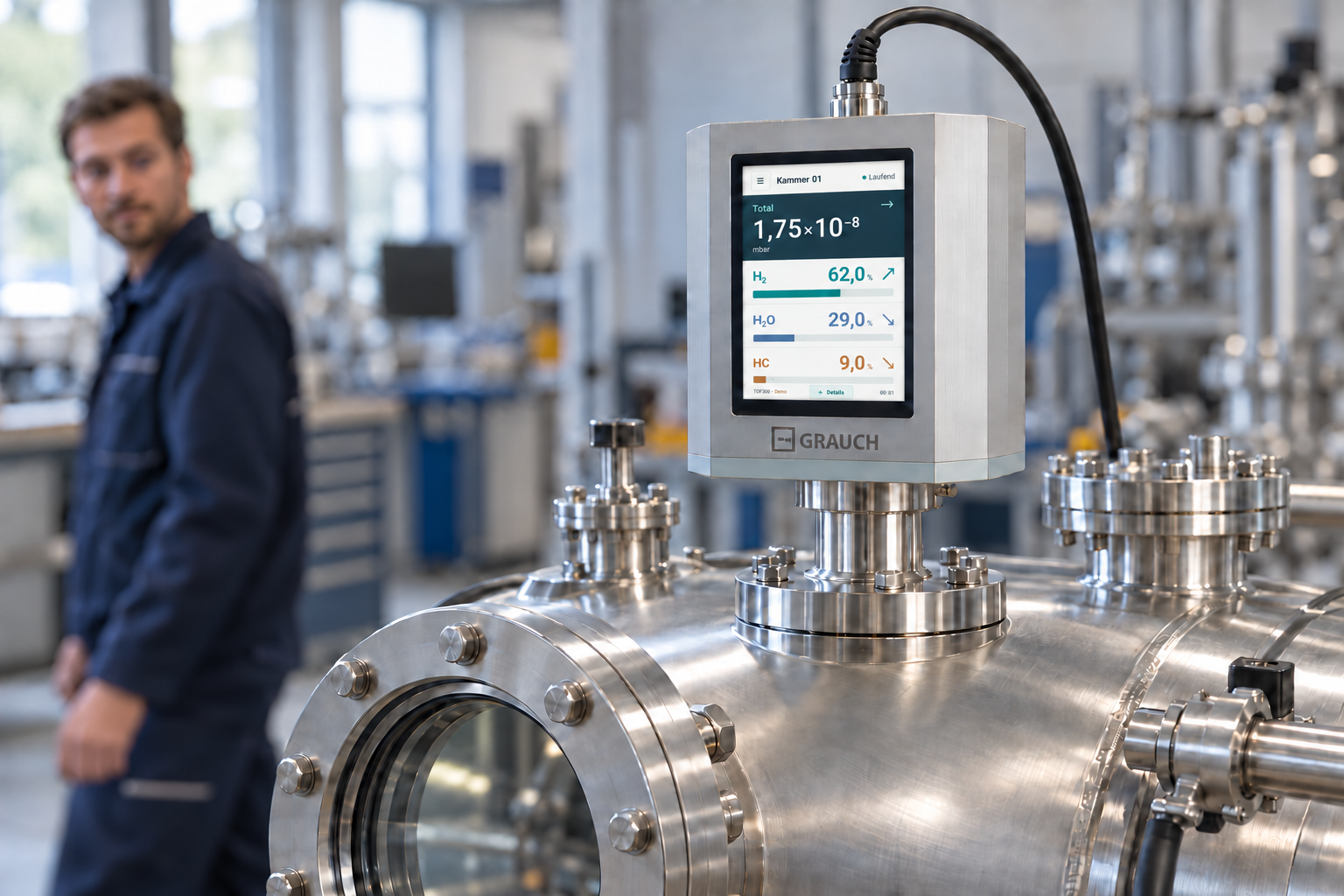 TOF300 · Product vision
All three insights come from real measurements. With our working demonstrator, we tracked gas composition during pumpdown, at base pressure and while introducing process gases.
Development statusPumping down, testing a seal, assessing cleanliness: three examples show what additional gas information can bring to everyday work.
Simplified sequence · No measurement data
The composition changes too.
The pump removes gas. The highlighted bar shows water in the residual gas; its signal is initially strong.
The horizontal axis shows the mass-to-charge ratio (m/z); bar height shows relative signal intensity. Assignments are simplified: signals from different gases can overlap, and molecules can form fragments. For example, the signal at m/z 28 may come from nitrogen or carbon monoxide. An individual peak therefore does not automatically identify a substance or prove a leak. The pressure trend has its own relative scale; the signal heights shown do not indicate concentrations.
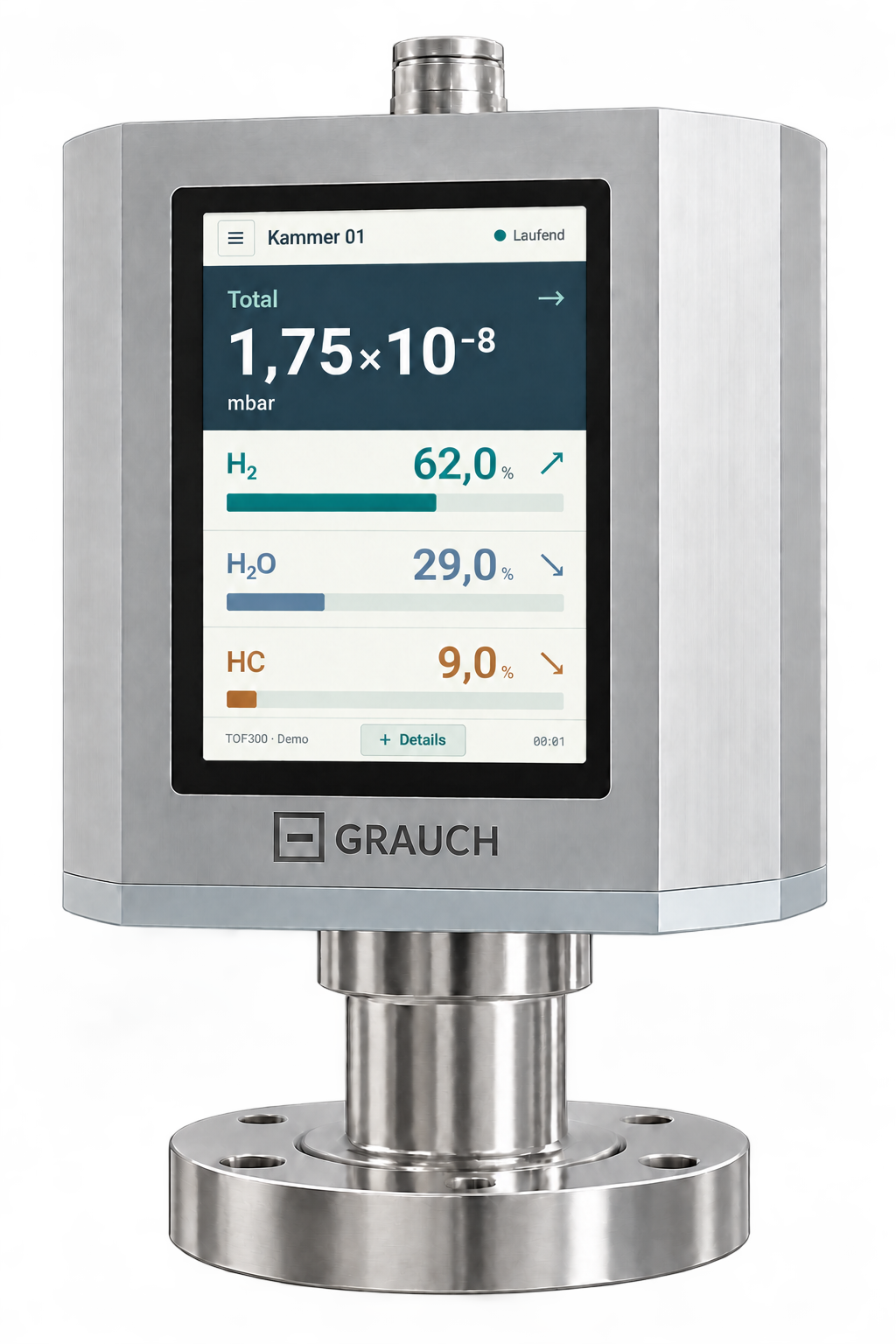
More insight. Fewer barriers.
We want to bring gas information to where it is needed: right at the chamber and into everyday work.
Track total pressure during pumpdown, determine base pressure and see which gases are present: TOF300 is being developed to combine all three in one instrument.
Our aim is to turn spectra into clear trends and useful guidance for each application.
Compact sensing, electronics and software as one integrated instrument. Easy operation is a key development goal.
Development targets, not guaranteed specifications. Measurement conditions and performance will be validated during development.
A working demonstrator. Initial testing on a coating system.
A robust, integrated measurement solution. Calibration, operation and testing for future use.
Our technology uses time-of-flight mass spectrometry. It separates gas signals by their mass-to-charge ratio, adding a new perspective on vacuum.
From gas to signal
Time-of-flight principle · schematicElectrons ionise gas molecules. Electric fields can move the positively charged ions.
We are developing our compact measurement architecture on this basis. A patent application has been filed for the technology.
Explore the spectrumWherever vacuum is part of everyday work, gas composition can reveal more of the picture. These applications guide our development.
Examine residual gases before introducing process gases. Compare conditions and investigate changes more precisely.
Alongside base pressure, unusual gas signals could indicate leaks or contamination, providing a starting point for further checks.
From a single vacuum setup to an entire institute: gas information is intended to help researchers better understand experimental conditions.
Track gas composition during thermal-vacuum tests for additional insight into outgassing and the cleanliness of the chamber and test article.
Examine residual gases and changes after venting, maintenance or process changes. For a better understanding of conditions in the chamber.
Requirements vary between systems. TOF300’s suitability will be tested for each application.
Gas analysis applications in detailWe bring together physics, electronics and sensing. We are driven by the question of how additional measurement information can create a better understanding of vacuum.

Physics & strategy
Co-founder
Electronics & embedded systems
Co-founder
Sensing & system integration
Co-founderBuilding the next generation together.
Would you like to help shape this vision as a strategic partner or investor? Let’s discuss how gas information can become a natural part of everyday vacuum work.
Let’s talk